

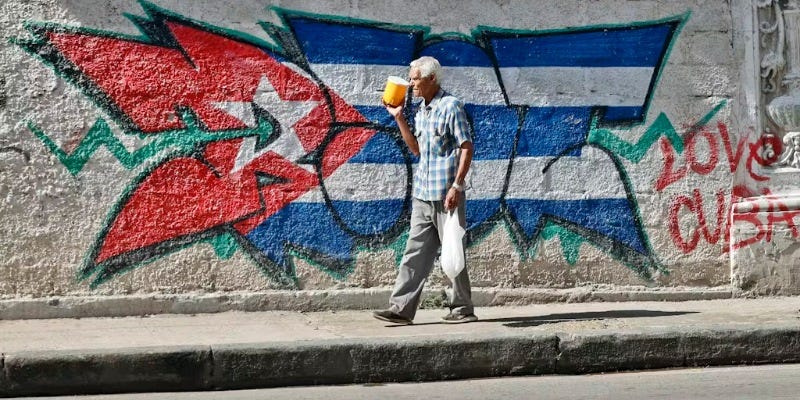
Cuba has reached a breaking point that even its crisis-hardened leadership can no longer ignore. The island is running out of fuel, having received its last shipment on January 9. Airlines have begun to cancel flights at the height of the tourism season, cutting off the tourism lifeline that accounts for most of the country’s foreign currency. Massive power outages are now routine. The United Nations has warned of a possible humanitarian collapse.
For the first time in decades, Cuba’s 67-year-old regime faces a crisis where its traditional survival tools – external bailouts, mass emigration, and austerity – may no longer be enough.
In the first part of this two-piece series, I argued that Cuba isn’t Venezuela. However successful the Trump administration claims to have been in capturing Nicolás Maduro, Cuba’s regime is much harder to dislodge.
Despite all the rhetoric, regime change in Havana is the last thing Washington wants — at least, for now.

US-Cuba hostility is not new — it dates back to the revolution’s nationalisation of American assets and Cold War alignment with Moscow, which prompted the 1962 embargo.
Since then, Washington’s approach has cycled between pressure and limited engagement: Carter’s openings, Reagan‑era hardening, Clinton’s migration deals, the Obama thaw, and then a sharp turn back to sanctions under Trump’s first term.
President Trump’s return to office has produced the most aggressive strategy in decades.
With Nicolás Maduro captured and access to discounted Venezuelan oil cut off, Washington has moved to close Cuba’s remaining energy lifelines by threatening tariffs on countries that ship fuel to the island and leaning on partners like Mexico.
But the current pressure represents something qualitatively different. President Trump and Secretary of State Marco Rubio — a Cuban American who has spent years crafting hardline Cuba policy — frame this operation as the next chapter in their effort to roll back left‑wing regimes in the hemisphere, following the US operation in Venezuela on January 3.
“Make a deal before it is too late”, President trump told Cuban leaders. The message to Havana couldn’t be blunter: negotiate on US terms or face an energy collapse that could push the country into a new “Special Period” — but this time, with no allies ready to bail it out.
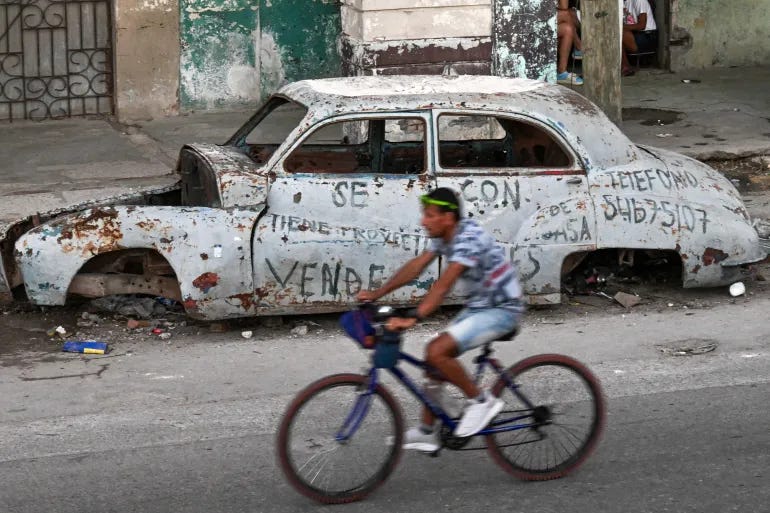
With Venezuela’s Maduro captured, Cuba has lost its main oil patron. Mexico remains sympathetic but cannot risk US tariffs or trade retaliation, especially at a time when the US-Mexico-Canada free trade agreement (the old NAFTA) is to be renegotiated. Russia is stretched thin in Ukraine. China, while building intelligence infrastructure in Cuba, has shown no appetite for a costly bailout so close to American shores.
The US administration’s leverage is unprecedented, leaving Havana with virtually no options beyond negotiation.
So what is Washington seeking in a deal with the Cuban regime?
What the US administration wants from a deal
Behind the rhetoric, Washington’s goals are more strategic than ideological.
Delivering regime change in Cuba is particular difficult. Cuba has no official in place to act as interim leader, unlike Delcy Rodríguez (a potential interim figure in Venezuela). With most opposition leaders in prison or in exile, it is unclear who would lead the country should the regime fall.